

Dr. Maria Montessori’s “follow the child” philosophy is often misinterpreted to mean that children are allowed to do whatever they want in a classroom.
Children are allowed freedom within limits to develop to their full potential. They are guided by Montessori-credentialed teachers in a classroom with specific Montessori materials and lessons in language arts, mathematics, practical life, and cultural subjects.
In a Montessori classroom, the role of the teacher is fundamentally different from that of a traditional educator. Rather than being the sole source of knowledge at the front of the room, Montessori teachers act as guides, facilitators, and keen observers. Their work is less about directing the class as a whole and more about nurturing each child’s unique path of growth and discovery.
A key responsibility of Montessori teachers is individualized observation. They watch closely to understand each child’s interests, strengths, and areas that need support. Instead of delivering the same lesson to every student, teachers introduce activities that align with developmental readiness and curiosity. This personalized approach ensures that every child progresses at their own pace, receiving the encouragement and challenges they need to thrive.
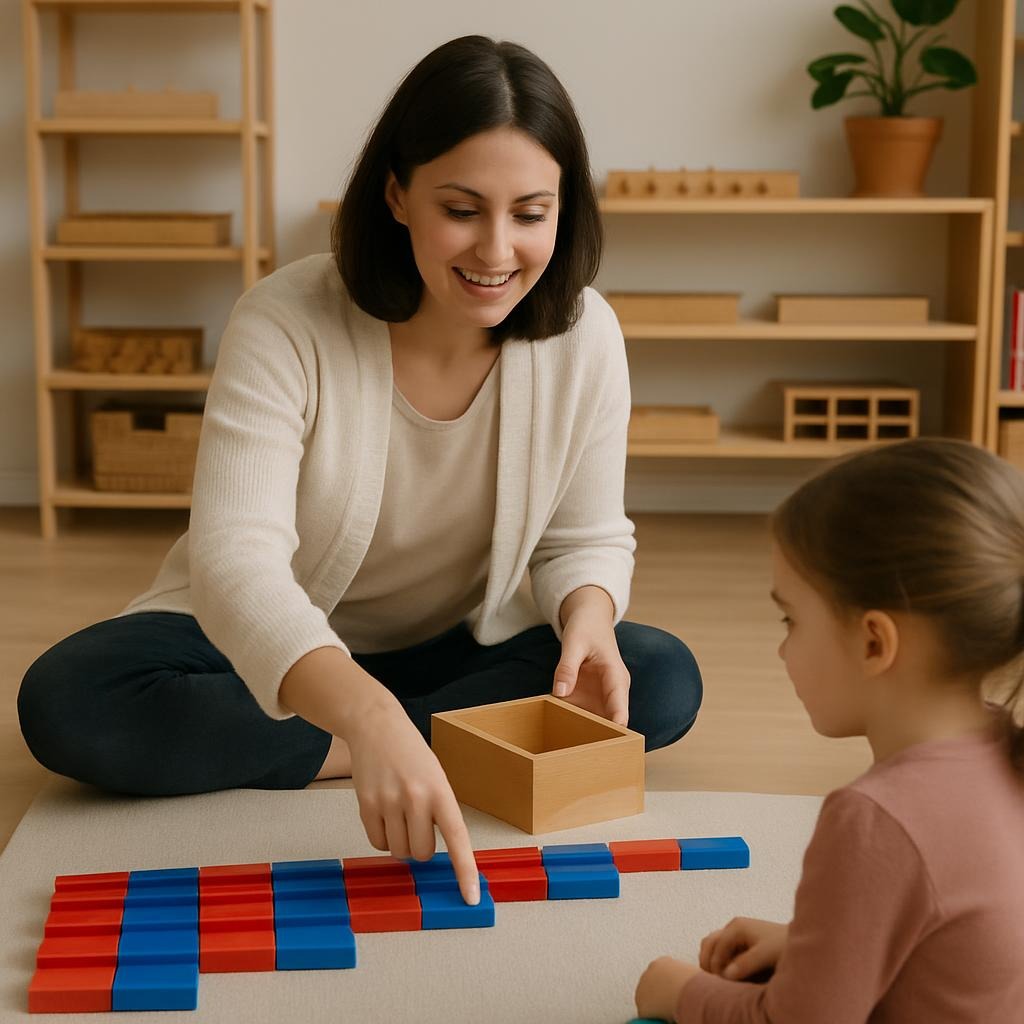

Montessori teachers also serve as preparers of the environment. They carefully design and maintain the classroom so that it is orderly, beautiful, and filled with purposeful materials. Every shelf, activity, and piece of furniture is arranged with intention—inviting children to explore independently. By curating an environment that matches children’s developmental stages, teachers empower students to take ownership of their learning while building confidence in their ability to make choices.
Another vital aspect is modeling values and behavior. Montessori teachers embody respect, patience, and empathy. Through their words and actions, they show children how to treat others with kindness, resolve conflicts peacefully, and care for the classroom community. This modeling shapes not only academic habits but also emotional and social intelligence—skills that extend far beyond school walls.
Finally, Montessori teachers act as mentors and quiet guides. They know when to step in with gentle direction and when to step back, allowing a child to solve problems and experience the joy of discovery. This delicate balance fosters independence, intrinsic motivation, and a lifelong love of learning.
In short, the Montessori teacher is not just an instructor, but a guide, observer, role model, and architect of the learning environment. Through their thoughtful presence, children develop into confident, capable, and compassionate individuals prepared for the challenges of both school and life.